
Beyond False Choices: Turning Climate Debate into Real-World Progress
Written by: Rajib Ghosal, Independent Consultant, Climate Justice and Sustainability, Climate Restoration Ambassador
For decades, we have pursued economic growth while undermining the natural systems on which lasting prosperity depends. We have built industries, expanded cities, and increased production, often at the expense of forests, biodiversity, clean water, and a stable climate. Now, the environmental damage created by our development choices threatens to reverse the very progress we sought to achieve.
Floods, droughts, extreme heat, rising seas, and ecosystem degradation increasingly threaten infrastructure, agriculture, public health, livelihoods, and poverty reduction. Resources that could support long-term development are diverted to disaster response and reconstruction, while investment in prevention, resilience, and restoration remains inadequate.
We have scientific knowledge, technologies, international agreements, financing mechanisms, and a sophisticated vocabulary of commitments. Yet the scale of action remains far below the scale of the challenge. Why? One reason is that we keep treating interconnected problems as opposing choices: Global North versus Global South, development versus conservation, growth versus sustainability, mitigation versus adaptation, and climate justice versus economic pragmatism.
These distinctions are not imaginary. They reflect real inequalities, competing interests, and legitimate historical grievances. The danger begins when useful distinctions harden into political identities, negotiating positions, and ultimately excuses for delay. We become so occupied with defending our respective sides that we lose sight of what we came together to accomplish.
Beyond the Global North–Global South divide
The distinction between the Global North and Global South remains important. It reflects enduring inequalities in wealth, industrialization, historical emissions, technological capacity, and access to affordable finance. Countries that contributed disproportionately to the climate crisis cannot reasonably demand identical commitments from those with fewer resources and far smaller historical contributions. The principle of common but differentiated responsibilities and respective capabilities (CBDR-RC) recognizes precisely this reality.
Yet this distinction no longer tells us enough about the world we inhabit. Wealth and deprivation coexist in both North and South. Advanced industries operate alongside communities lacking secure housing, clean water, reliable electricity, or protection against extreme weather. Some emerging economies have considerable technological and financial capacity; others face high debt burdens, fragile institutions, and limited fiscal space.
A country’s historical circumstances, political influence, and exposure to climate risk cannot be reduced to national income or geographic category. Historical responsibility, current emissions, per-capita consumption, capacity to act, and vulnerability are related, but they are not interchangeable.
National categories still matter for treaties, finance obligations, and accountability. They are not, however, a substitute for understanding conditions on the ground. Good policy must be able to distinguish a community with urgent adaptation needs from a corporation with substantial capital, even when both are located within the same national border.
The objective should not be to abandon the language of climate justice. It should be to make that language more precise, so that responsibilities and support are allocated fairly—and action becomes more effective.
When politics displaces implementation
Climate negotiations must address difficult political questions: Who should pay? Who should act first? Who receives support? Who sets the rules? Who bears the costs of transition? These questions are legitimate because energy access, land rights, public expenditure, and economic opportunity are inseparable from questions of justice and power.
The problem is not that climate action is political. It is that political positioning too often displaces the practical work that politics is supposed to enable. We can spend years debating a financing commitment while communities remain without climate-resilient infrastructure. We can agree on ambitious strategies without ensuring that local institutions have the staff, resources, and authority to implement them.
This gap is especially visible in implementation. Local agencies may be asked to deliver complex projects through short funding cycles, disconnected procurement systems, and reporting requirements that reward easily counted activities instead of durable results. Political consensus at the international level is important, but local delivery capacity is what makes that consensus real.
Diplomacy matters only when it helps convert commitments into funded, measurable, and accountable results. The ultimate test is not whether every delegation has defended its position. It is whether emissions fall, ecosystems recover, communities become safer, and people’s lives improve.
Responsibility is differentiated—but action cannot be optional
Historical responsibility is essential to any fair climate framework. High-income industrialized economies have benefited from fossil-fuel-intensive development and carry substantial obligations to decarbonize, provide accessible finance, and support technology transfer. But acknowledging that history cannot mean overlooking today’s emissions or tomorrow’s development choices.
China is the largest annual emitter of fossil carbon dioxide, while India is also a major emitter in absolute terms—even though India’s per-capita emissions remain well below those of many wealthy countries.[2] Annual emissions, cumulative historical emissions, consumption-based emissions, and emissions per person answer different questions. No single measure should be used to dismiss the others.
It is entirely legitimate for developing countries to insist that wealthy countries honor their obligations. It is equally legitimate to expect rapidly industrializing economies to integrate their present and future emissions trajectories into development planning. These are complementary requirements, not competing demands.
Historical responsibility should shape the distribution of burdens. Present emissions should inform mitigation priorities. Financial and technological capacity should determine what each actor can contribute. Development needs should shape the pace and means of transition. Vulnerability should guide support. This is more demanding than dividing the world into two camps—but far more useful.
Climate finance should be judged by what it achieves
Climate finance makes these contradictions especially visible. Developing countries often face a combination of poverty, infrastructure deficits, growing climate losses, expensive borrowing, and restricted public budgets. Wealthy economies face political and fiscal constraints of their own. These realities help explain difficult negotiations; they do not remove the need for fair and effective financing.
The gap between need and delivery is stark. The United Nations Environment Programme’s 2026 Adaptation Gap Report estimates that developing countries will need about US$305 billion annually for adaptation by 2035. International public adaptation finance from developed to developing countries amounted to only US$28.2–31.7 billion in 2024. Even if the COP30 aspiration to triple those flows by 2035 is achieved, UNEP estimates that it would meet only 20–29% of the need.[1]
But the issue is not simply how much money is pledged. We must ask whether it reaches vulnerable communities, reduces climate risk, protects ecosystems, builds durable local capacity, and avoids creating unsustainable debt. A grant, concessional loan, guarantee, and commercial investment may each play an important role, but they impose different costs and risks; they should not be treated as interchangeable simply because they can be counted under one headline figure.
Project preparation also matters. Communities and institutions need help conducting assessments, securing land and community agreements, designing viable projects, and measuring outcomes before large-scale capital can arrive. Without that early support, the places most in need of investment may be the least able to access it. Funding architecture should address this practical bottleneck, not merely raise the size of future pledges.
We need financing systems that link public commitments, development banks, domestic resources, and responsible private investment to clearly defined outcomes. Climate finance should not be an accounting competition. It should be an instrument for measurable public value, with equitable sharing of both costs and benefits.
Development and environmental protection must reinforce one another
For people living with poverty, unemployment, unreliable electricity, or inadequate infrastructure, development is not an abstraction. It is the difference between opportunity and exclusion. Asking communities to protect nature without offering viable economic alternatives is neither just nor sustainable.
Yet the opposite argument—that environmental protection can wait until development is complete—is equally flawed. Development built on degraded soil, exhausted water resources, polluted air, ecosystem destruction, and rising climate vulnerability undermines its own foundation. Growth that concentrates benefits while transferring environmental costs to poorer communities is not necessarily progress.
There are real trade-offs. Renewable energy infrastructure requires land and minerals. Conservation can restrict access to resources if local rights are ignored. Industrial transitions can affect employment. Nature-based solutions, hydropower, and carbon projects can deliver benefits while also creating social and ecological risks.
What matters is how we design development: rigorous assessment, meaningful community participation, respect for land and Indigenous rights, transparent decisions, credible safeguards, and fair sharing of benefits. The real divide is not between development and the environment. It is between development that accounts for its consequences and development that pushes those consequences onto others.
Mitigation and adaptation belong in the same strategy
Mitigation remains indispensable: every increment of warming prevented reduces future risks. Adaptation is equally urgent: climate impacts are already affecting communities, and emissions reductions alone cannot protect people from the damage already underway. Restoration of damaged ecosystems and natural climate systems adds another essential dimension.
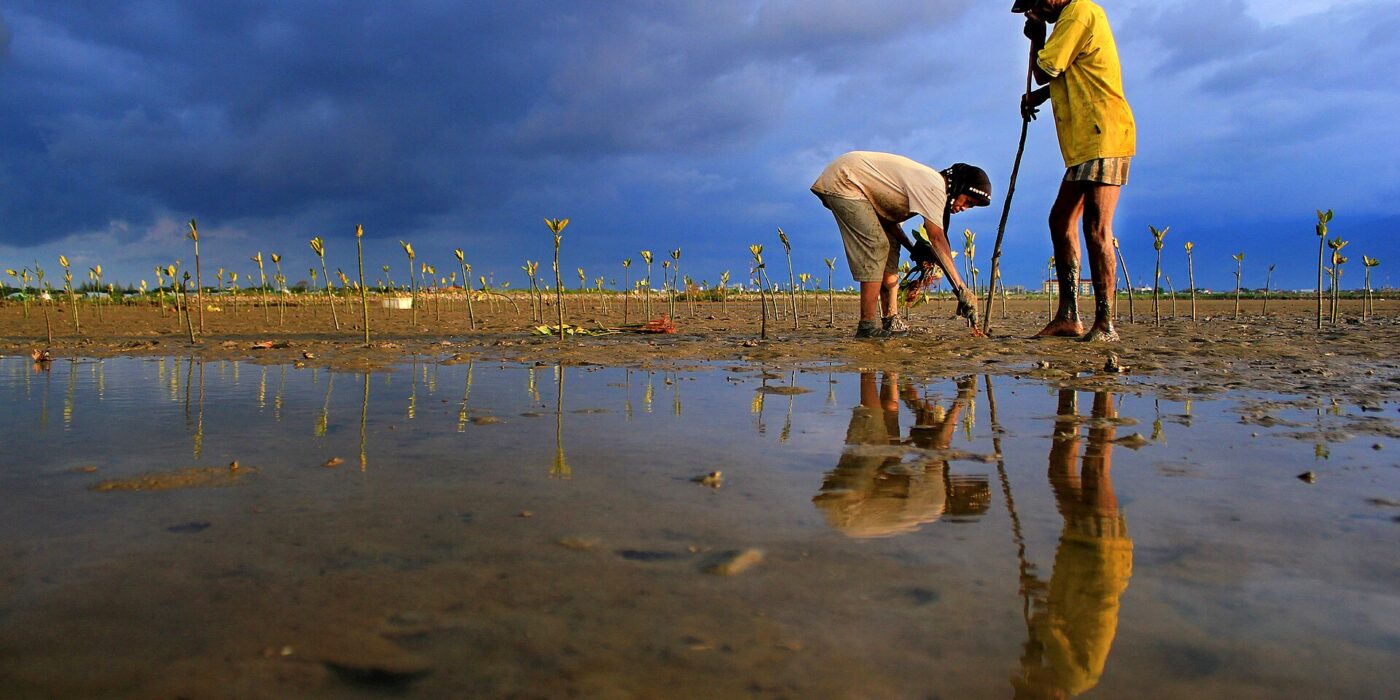
Consider a coastal community confronting rising seas, declining fisheries, damaged roads, and unreliable income. Its needs cannot be met through a single-sector project. Effective action may involve mangrove restoration, resilient infrastructure, clean energy, water systems, livelihood support, early-warning capacity, and stronger local institutions—all working together.
Yet funding rules and organizational mandates often divide these interventions into separate categories. A project may be asked to prove one narrowly defined benefit even when success depends on several mutually reinforcing improvements. Accountability is necessary, but accounting systems should recognize interdependence rather than reward fragmentation.
Integration does not mean abandoning specialist knowledge or hiding poor performance behind a broad narrative. It means identifying how different interventions affect one another, assigning clear responsibilities, and measuring results both individually and as part of a larger system. A restored wetland, for example, can protect biodiversity, support livelihoods, store carbon, and reduce flood exposure—but each claim needs appropriate evidence.
We need financing and implementation models that can support connected solutions while still measuring their distinct outcomes, protecting rights, and maintaining transparent oversight.
Evidence must guide politics—not be used to disguise it
Technical expertise cannot settle every political choice. Scientific models can estimate climate pathways; risk assessments can identify vulnerabilities; economic analysis can compare investments. None can independently decide whose land should be protected, how transition costs should be shared, or which communities should receive compensation.
These decisions require legitimate public institutions, participation, transparency, and accountability. But recognizing their political nature must not become permission to ignore evidence or manipulate it. We must distinguish scientific findings from negotiating claims, financial commitments from actual disbursements, announced projects from functioning projects, and national achievements from improvements in people’s lives.
Every initiative should answer four questions: What changed? For whom? At what cost? And with what evidence?
From fragmented climate action to Climate Restoration
The path forward is not to choose between development and conservation, mitigation and adaptation, or economic prosperity and environmental responsibility. It is to recognize that they are connected dimensions of the same challenge—and to build institutions capable of addressing them together.
Climate Restoration offers a wider ambition: not merely slowing environmental decline, but helping restore the conditions that enable people, economies, and ecosystems to thrive. This requires rapidly reducing ongoing emissions, restoring damaged ecosystems, responsibly removing excess carbon dioxide from the atmosphere, strengthening resilience, and creating sustainable opportunities for communities.
Such an approach cannot be delivered through declarations alone. It requires practical models that connect local ownership, science, finance, public institutions, enterprise, and measurable outcomes. Projects should be designed so that environmental recovery and economic opportunity reinforce each other, rather than compete for attention or funding.
In practice, this could mean bringing restoration, renewable energy, regenerative agriculture, water security, training, and local enterprise into a shared development strategy. Not every intervention will be appropriate everywhere, and no approach can replace rigorous safeguards. The principle is simpler: design for the needs of a whole community and ecosystem, rather than assuming that separate projects will somehow add up to transformation.
The measure of success should not be the number of agreements we sign, the size of our pledges, or how effectively we defend our negotiating positions. It should be what we actually restore, what we improve, and what we leave for future generations.
The question is no longer whether we can afford to act together. It is whether we can afford to continue acting separately.
References
[1] United Nations Environment Programme (2026), Adaptation Gap Report 2026: Ready? Not. https://www.unep.org/en/publications/report/adaptation-gap-report-2026
[2] Global Carbon Project, Global Carbon Budget 2025, Earth System Science Data (2026). https://doi.org/10.5194/essd-18-3211-2026