
From Zoom to Shoreline: LOF MRV at Cooley Landing
At the Climate Restoration Alliance, much of the work begins on Zoom: strategy calls, technical discussions, presentations, and planning sessions about how to build the Climate Restoration Industry. That work matters. But it is especially exciting when the work leaves the screen and enters the field.
That is what made our recent LOF MRV test at Cooley Landing, California, so meaningful. LOF stands for Localized Ocean Fertilization. MRV stands for Measurement, Reporting, and Verification.
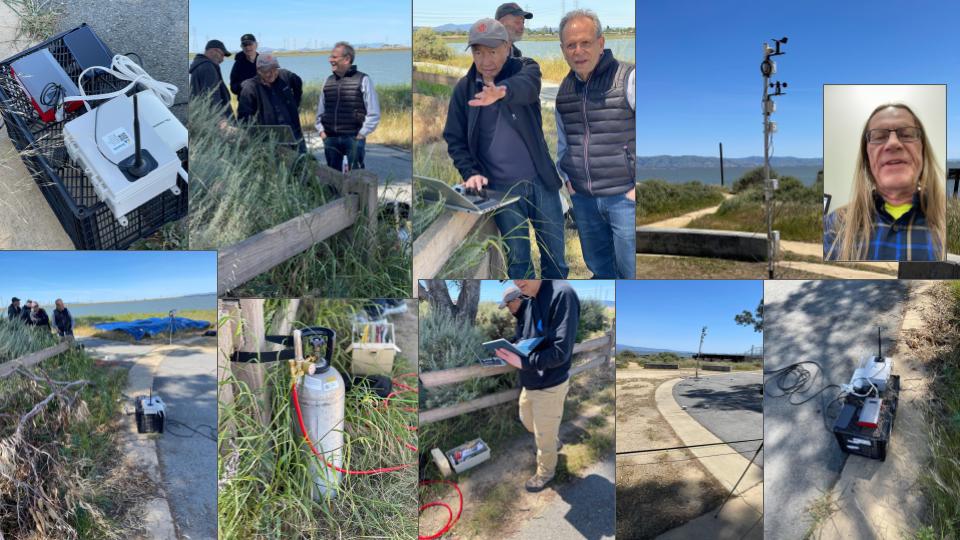
This was not a large deployment or a public demonstration. It was a practical field test designed to help us improve how we measure CO2 movement in real conditions using a controlled release and a line of sensors downwind. If climate restoration is going to operate at scale, measurement must be practical, credible, and field-tested.
Cooley Landing offered a useful setup for that work. The shoreline and the prevailing winds coming off San Francisco Bay made it possible to simulate key parts of a future ocean-based measurement system without the immediate complexity of boats and buoys.
Ray and Jerry handled the CO2 system. Ray sourced the 20-pound CO2 tank, the regulator with flow meter and flow control, and the red tubing that connected the flow gauge outlet to the emitter tube. He also used paracord to suspend the emitter tube at the desired height and adjusted the flow rate during the test. The team ran two trials: one with the sensor pole at the maximum distance of 55 feet, with 11 feet between each pair of sensors on the ground, and a second at about half that distance.
Peter was there. Jim was there. Ray was there. Jerry was there. And that matters.
Because this is what building a new industry looks like at the beginning: not just ideas and presentations, but people showing up in the wind with equipment, sensors, tubing, and patience.
From a distance, the test may have looked simple. But it marked something important: the move from talking about measurement to doing measurement. If we want climate restoration to earn scientific confidence and public trust, we need MRV that works in the real world.
That is why this day was so energizing. After so many hours spent imagining the future, it was deeply encouraging to stand on the shoreline and watch the work become physical.
This is how capability gets built: step by step, test by test, dataset by dataset.
The Climate Restoration Industry will not be built by vision alone. It will be built by people willing to move from Zoom to shoreline, from concept to experiment, and from theory to field-tested systems.
Cooley Landing was one of those moments.
And that is exciting.
Stay tuned for more updates as CRA continues advancing LOF, MRV, and the practical foundations of the Climate Restoration Industry.
Get involved
Remember to follow our socials, and like and share our posts to help spread the word.
Facebook: https://www.facebook.com/ClimateRestorationAlliance
LinkedIn: https://www.linkedin.com/company/climate-restoration-alliance
TikTok: https://www.tiktok.com/@climate.restoration
Sign the pledge
https://climaterestorationalliance.org/join-us/
Join our next Mission Update on April 30
https://climaterestorationalliance.org/event/climate-restoration-2050-mission-update-apr-30-2026/