
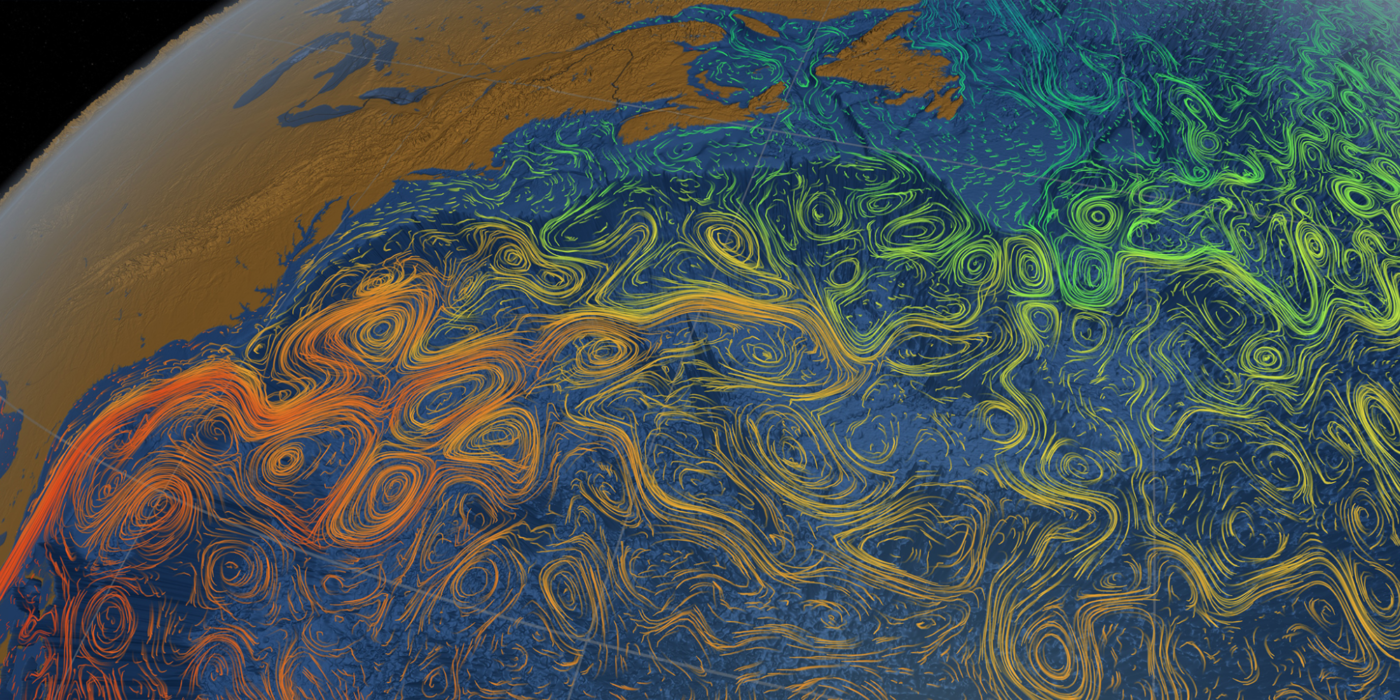
The ocean already absorbs about a quarter of all the CO2 humans put into the atmosphere every year. That’s not a small number. But for a long time, scientists weren’t sure exactly where or how that absorption was happening at scale. A 2025 peer-reviewed study is starting to answer that question, and the answer points to one of the most overlooked features in the ocean: mesoscale eddies.
Climate scientist Paul Beckwith has published two videos breaking down this research, and the science behind it goes back further than you might expect. In 1905, a young Swedish oceanographer named Vagn Ekman published his PhD thesis explaining why icebergs don’t travel in the direction of the wind. The answer involved the Earth’s rotation creating a spiraling effect on ocean currents, now called the Ekman spiral. Over a century later, that same physics turns out to be central to how we might restore the climate.
Here’s the basic picture. The ocean is covered in rotating water formations called mesoscale eddies, ranging from 100 to 400 kilometers wide. When these eddies spin in an anticyclonic direction, they push water downward, carrying dissolved CO2 with them. Studies now show that these downwelling eddies sequester significantly more carbon than the surrounding ocean, with some doing it at three to five times the background rate. They’re not rare. They exist by the thousands, concentrated along major ocean currents like the Gulf Stream and the Kuroshio Current off Japan.
The connection to climate restoration comes from what happens next. These downwelling eddies are low in nutrients, which limits biological activity. But add iron, a nutrient that’s naturally scarce in the open ocean, and you can trigger phytoplankton blooms. Those organisms absorb CO2 through photosynthesis, and when the eddy pumps them downward, that carbon goes with them and becomes inert in the deep ocean, away from the atmosphere.
This is exactly the kind of work the Climate Restoration Alliance was built to support. Our mission is to restore CO2 to pre-industrial levels by 2050 by amplifying natural processes that have worked before (we are preparing another post with more information on this soon). Ocean eddy seeding is one of those processes. It’s not a theoretical fix. The physics is well understood, the eddies are already there doing their job, and the question now is whether we commit to scaling it.
Beckwith frames climate restoration as a three-legged stool: cut emissions, draw down carbon, and manage solar radiation in parallel. The second leg is where ocean eddies come in, and it’s the leg that gets the least attention. That needs to change.
Nature has been showing us the way. Our job is to follow it.
Watch Paul Beckwith’s videos on Ekman pumping and mesoscale eddies on his YouTube channel.